Grist consultant for the public sector: from scoping to self-sufficient teams
From shared spreadsheets to structured data: we start by listening to you. We scope your project, set it out in a detailed specification, build it with you in Grist and train your teams, so that your staff can become more self-sufficient day to day.
Start with your data, not the tool
Spreadsheets emailed around, then reconciled by hand: with them come re-keying, errors and spreadsheets that multiply with no link between them. Grist offers a way out: a shared spreadsheet whose tables are linked to one another, with clear rules on who can see or edit what.
The data still has to be well organised, though. Otherwise, the same problems simply move from one tool to the next. A polished interface is not enough: it cannot fix poorly structured data. That is why we always start by listening to you and understanding your process.
Who we work with
Our services are designed first and foremost for the public sector, whatever your starting point: a first Grist to build, spreadsheets shared by email or a file that only one person knows how to keep up to date, a Grist document that has become hard to change. Your team doesn't use Grist yet? We help you get started on grist.numerique.gouv.fr.
We work at every stage, including training your teams and supporting them as they start out on Grist. We also work with non-profits and businesses.
Your first Grist: a safe migration
Is your team leaving its shared spreadsheets behind, or starting out on grist.numerique.gouv.fr? We support you from start to finish: understanding your processes, designing the structure of your data, bringing over your Excel or LibreOffice files, building your first documents and training your teams.
A migration that relies on one or two newly trained staff members remains fragile: the choices made at the start shape everything else, and the old spreadsheet's flaws can resurface in Grist. Our role: to anticipate these issues and make your migration safe.
What you receive: your Grist documents, built with your data, their documentation, and teams trained to keep them running.
Every migration is tailor-made: let's talk about your project.
Book a callReworking a Grist document that has become too complex
Your team already uses Grist, but the document has grown over time: tables nobody dares to change any more, duplicate columns, formulas nobody but their author understands, Excel re-imports that break the views.
We start by auditing your document and understanding how your team uses it, before changing anything. Then we restructure it with you. Our aim: a document your staff understand and can once again adapt.
What you receive: your restructured document.
Every rework is tailor-made: let's talk about your document.
Book a callOur method, step by step
Our engagements are led by Antoine, founder of Grist Factory: you have a single point of contact, from scoping to training your teams. About us
Four steps, in this order. For each one, here is what you receive.
1. Understand your project: scoping
Before touching a single file, we take the time to listen to you and understand your project as a whole:
- each person's role (who enters the data, who checks it, who uses it) and what gets in their way;
- the whole flow of work, from start to finish, and where your data fits at each stage;
- how the data relates to your work: what it describes and the rules it must follow.
We do this work with all the departments involved, getting them to talk to one another, so that each one can voice its concerns. We also identify what already works and should be kept. This is what we need before we start: we build nothing until we have understood your project as a whole, or as much of it as we can.
What you receive: scoping leads to the detailed specification described in the next step.
2. Describe your needs: the detailed specification
We then write a detailed specification: a document that sets out your needs in detail. It builds on the concerns each department voiced during scoping. It becomes the shared reference between your team and us, before anything is built.
What you receive: the detailed specification, which is handed over to you.
3. Build your Grist with your data
We build your Grist documents with your own data, following the specification: tables linked to one another rather than copies passed from file to file, and clear rules on who can see or edit what. We usually work on grist.numerique.gouv.fr, or in the instance your team already uses. We rely first on what Grist can already do, with no add-ons.
If your data currently sits in Excel or LibreOffice files, we bring it into this new structure, and we check this transfer with automated tests.
What you receive: one or more Grist documents, organised according to the specification, and, where usage justifies it, a custom widget.
4. Train your staff and make them self-sufficient
Our aim: your staff understand their Grist document and become more self-sufficient day to day. We train your teams, both in the basics of Grist and in their own documents, and we support them through their first steps.
What you receive: technical documentation explaining how your Grist documents are built, and a getting-started guide for the staff who use them. Where needed, we add a video tutorial. Your documents stay in your instance, with their documentation.
You can hire us for the whole process or just part of it, for example scoping and the specification. Any set-up still starts with scoping, even a brief one: it is what lets us get it right.
Custom Grist widgets: going further
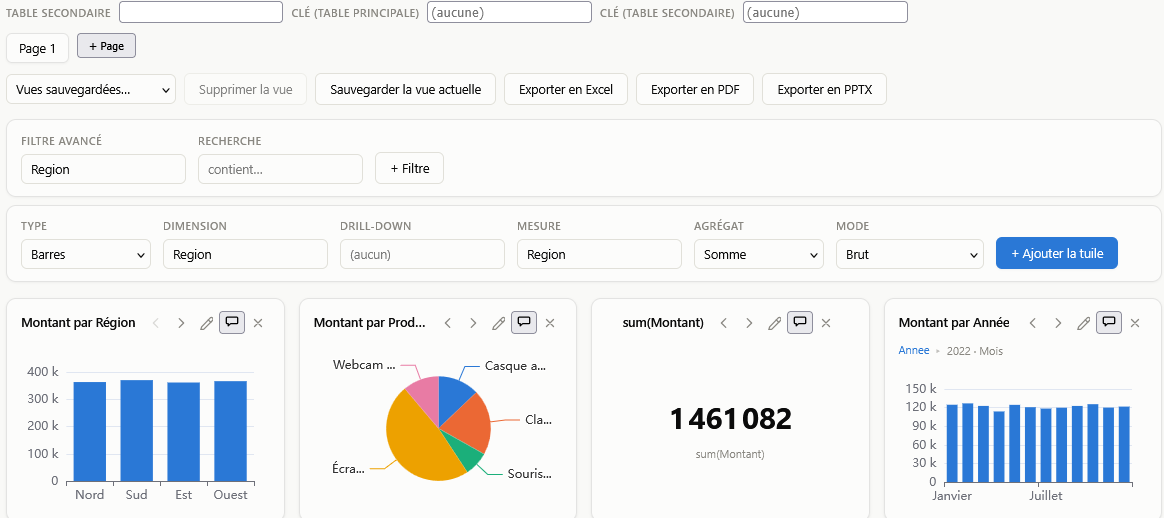
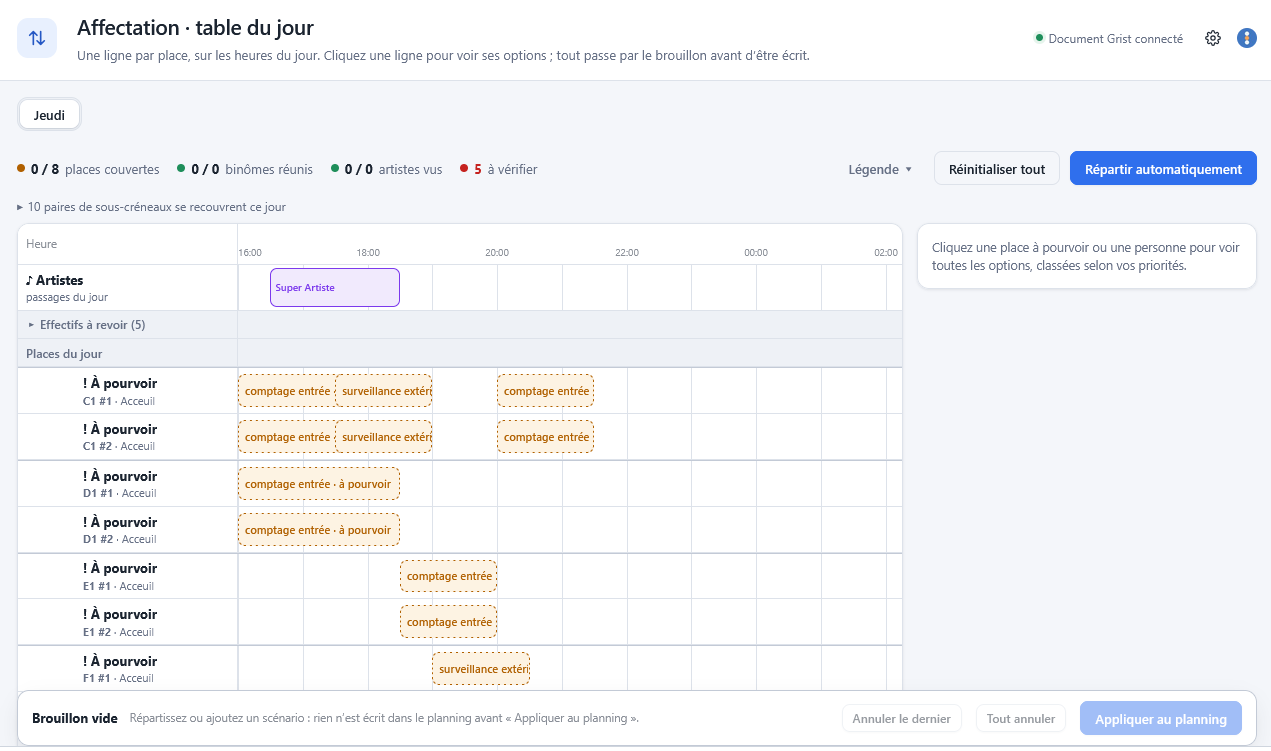
When Grist alone is no longer enough, a custom widget takes over. A widget is a small add-on that gives Grist a specific function: a data-entry interface suited to your staff, a document produced for each row of a table, a schedule, a form in several parts.
We build it on top of well-structured data, never in its place, and we design it to be picked up without training, like online software. It adds to your Grist rather than replacing it.
If you wish, we develop it as open source: your IT department can review its code before deploying it, your team keeps it and can develop it further, and other teams can benefit from it. This is our way of contributing to the digital commons around Grist.
Examples: the widgets we publish as open source are shown on our Widgets page.
Which Grist instance we work in
Most often, on grist.numerique.gouv.fr, DINUM's instance. It is part of La Suite numérique, is hosted in France on SecNumCloud-qualified infrastructure and has received its security approval. Your team doesn't use Grist yet? We help you get started on it.
We also work on other instances: your local authority's or your public digital services operator's, an instance installed by your IT department, or Grist Labs' online service. Not every Grist feature is available everywhere: we check with you what yours allows before proposing a solution. We do not sell Grist licences or Grist hosting.
Where confidentiality matters, our access to your documents can be covered by a signed agreement. Security, hosting, personal data: see our answers
Training your teams and making your migration safe
There are free resources for discovering Grist, and we are happy to point you to them:
- On the French State's instance: the grist.numerique.gouv.fr team offers webinars, documentation, templates, user clubs and a forum.
- For training: the course "Construire son premier projet Grist" (Build your first Grist project) is available on Mentor, the French State's training platform.
- In local government: ANCT's data help desk ("guichet Données") supports public servants in handling their data.
They are not always enough. A migration that relies on one or two newly trained staff members remains fragile: the structural choices made at the start shape everything else, and problems often appear later. We have the expertise to anticipate these issues and make your migration safe: we train your teams, build their first documents with them and stay at their side until they are self-sufficient.
Pricing and getting in touch
Every engagement is tailor-made: its price depends on your project. Let's talk about your needs: an initial conversation will show whether we can help, and how.
Remote support, across the French-speaking world.
Book a callGrist is a trademark of Grist Labs.